Motivation
We revisit what it takes to judge a long trajectory and frame it as the composition of two subtasks: localization, which identifies the image holding the decisive evidence, and extraction, which reads the decisive detail from that image accurately.
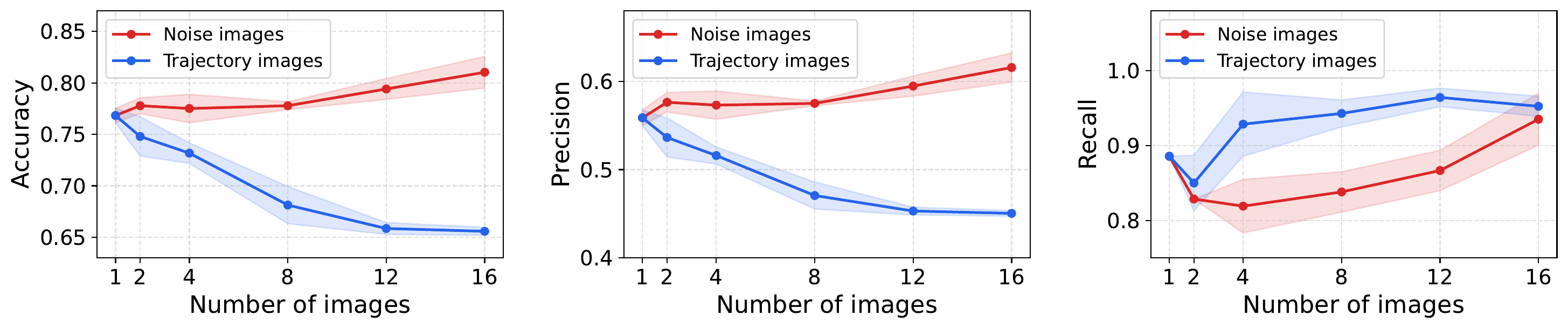
We observe that, even when the decisive image is always provided, adding more images from the same trajectory to a single forward pass degrades performance increasingly with their number. Competing content rather than context length drives the drop: as trajectory images accumulate, precision collapses while recall barely moves, so the judge reads accumulating plausible-looking details as evidence of success and the one decisive screenshot is drowned out.
The SeekJudge Framework
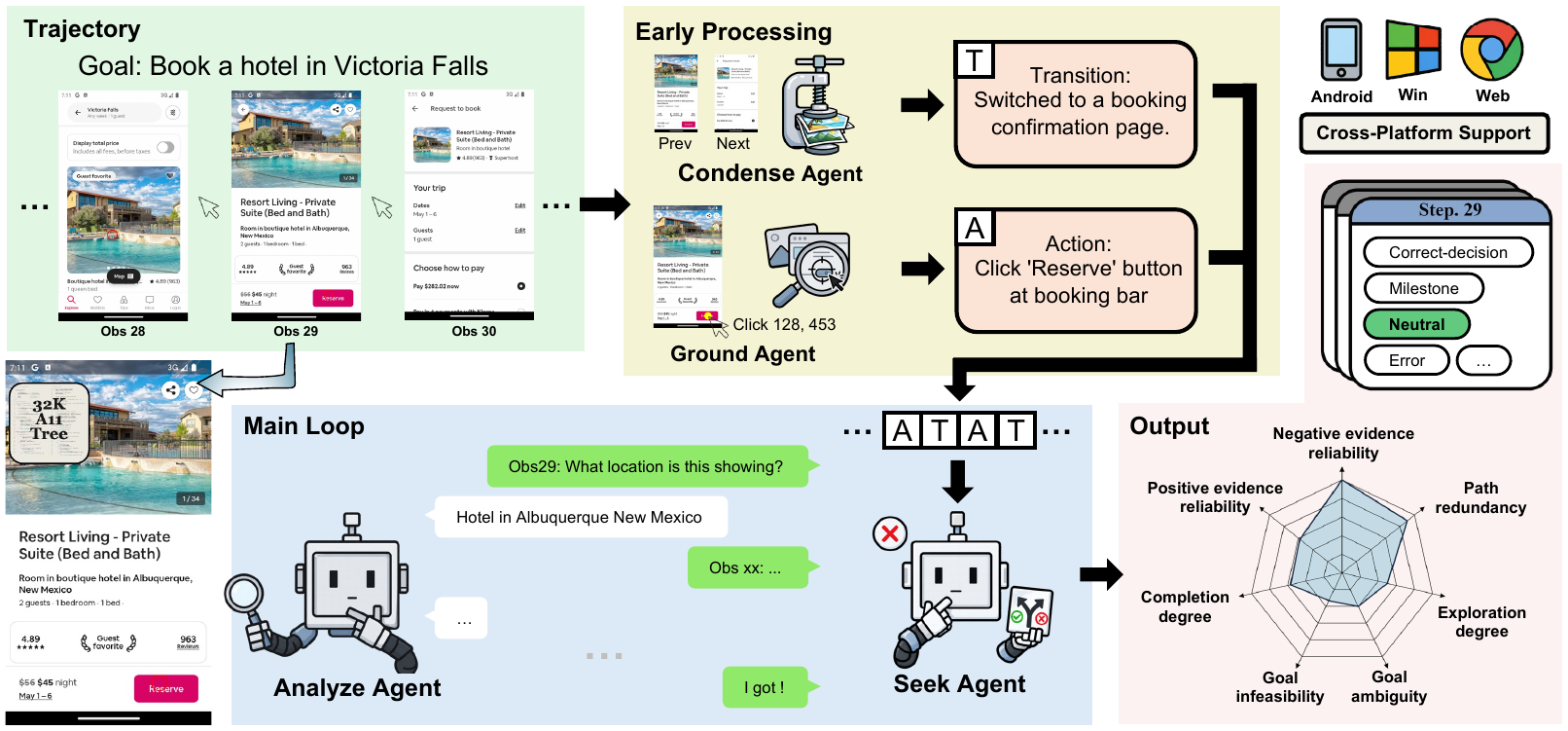
SeekJudge realizes this decomposition as a multi-agent framework whose four agents share one backbone model. The Condense and Ground agents first compress the whole trajectory into a compact timeline. The Seek agent takes this timeline as its initial context and runs a Seek–Analyze loop, querying the Analyze agent over several rounds for the evidence it still needs before emitting the final judgment.
Seek agent
The controller and the only agent that carries state across a run. It reads the condensed timeline and judges whether the accumulated evidence settles the instruction. When it is enough, it emits the verdict; when not, it names a single step and image id to inspect and sends a focused question to the Analyze agent.
Analyze agent
Answers one focused question about the single screenshot the Seek agent names and returns the decisive detail as text. It is stateless: every call starts fresh with only that question and image, so it acts as a tool the Seek agent invokes for a detail.
Condense agent
For each step it reads the two screenshots before and after the action and writes a few lines describing the state transition, the T entry of the timeline, turning the whole trajectory into a compact text timeline before the loop begins.
Ground agent
For each step it reads the pre-action screenshot together with the raw action the actor
executed, such as click 128,453, and identifies from the screenshot which
element those coordinates actually hit, the A entry of the timeline.
CUAStepBench
To support step-level evaluation we build CUAStepBench, a human-annotated benchmark of 278 tasks over 177 applications. Every trajectory carries a human verdict, and beyond that verdict each step receives a label.
Reinforcement Learning Results
Each reward model drives RL training of an actor across three task domains. Averaged over the six backbone-domain settings, SeekJudge exceeds native rule-based reward by 3.3 points of test success, and among model-based rewards it gives the highest average test success on both actor backbones.
| Reward | Chrome | Impress | OS |
|---|---|---|---|
| Rule-based | 12.75 | 30.43 | 25.56 |
| CUAJudge (GPT-5-mini) | 13.91 | 33.48 | 26.11 |
| OS-Themis | 10.14 | 32.46 | 25.00 |
| SeekJudge | 16.23 | 38.84 | 28.89 |
Offline Reward Benchmark
Training the SeekJudge-9B specialist sharpens the trajectory verdict and the step-level reading together. On CUAStepBench it lifts trajectory F1 over the Qwen3-VL-8B base and surpasses the closed-source CUAJudge despite its GPT-5-mini calls.
| Framework | Model | Trajectory F1 | Step F1 |
|---|---|---|---|
| Human expert | – | 82.2 | – |
| Large models | |||
| Codex | GPT-5.5 | 77.9 | – |
| CUAJudge | GPT-5-mini | 68.5 | 37.9 |
| SeekJudge | DeepSeek-V4-Pro-0423 + Gemini-3.0-Flash | 74.9 | 45.7 |
| Small models | |||
| OSReward | OS-Shepherd-9B | 68.4 | – |
| CUAJudge | Qwen3-VL-8B | 66.7 | 21.2 |
| OS-Themis | Qwen3-VL-8B | 59.8 | 15.5 |
| SeekJudge | Qwen3-VL-8B | 71.3 | 27.3 |
| SeekJudge | SeekJudge-9B | 74.2 | 38.0 |