Mitigating Conversational Inertia in Multi-Turn Agents

Yang Wan1, Zheng Cao1, Zhenhao Zhang2, Zhengwen Zeng3, Shuheng Shen3, Changhua Meng3, Linchao Zhu1
1Zhejiang University, 2University of Rochester, 3Ant Group
ICML 2026

Conversational inertia

Multi-turn agents can over-imitate their own previous responses.

We show that long interaction histories amplify diagonal attention to prior assistant outputs, biasing agents toward imitation when they should keep exploring.

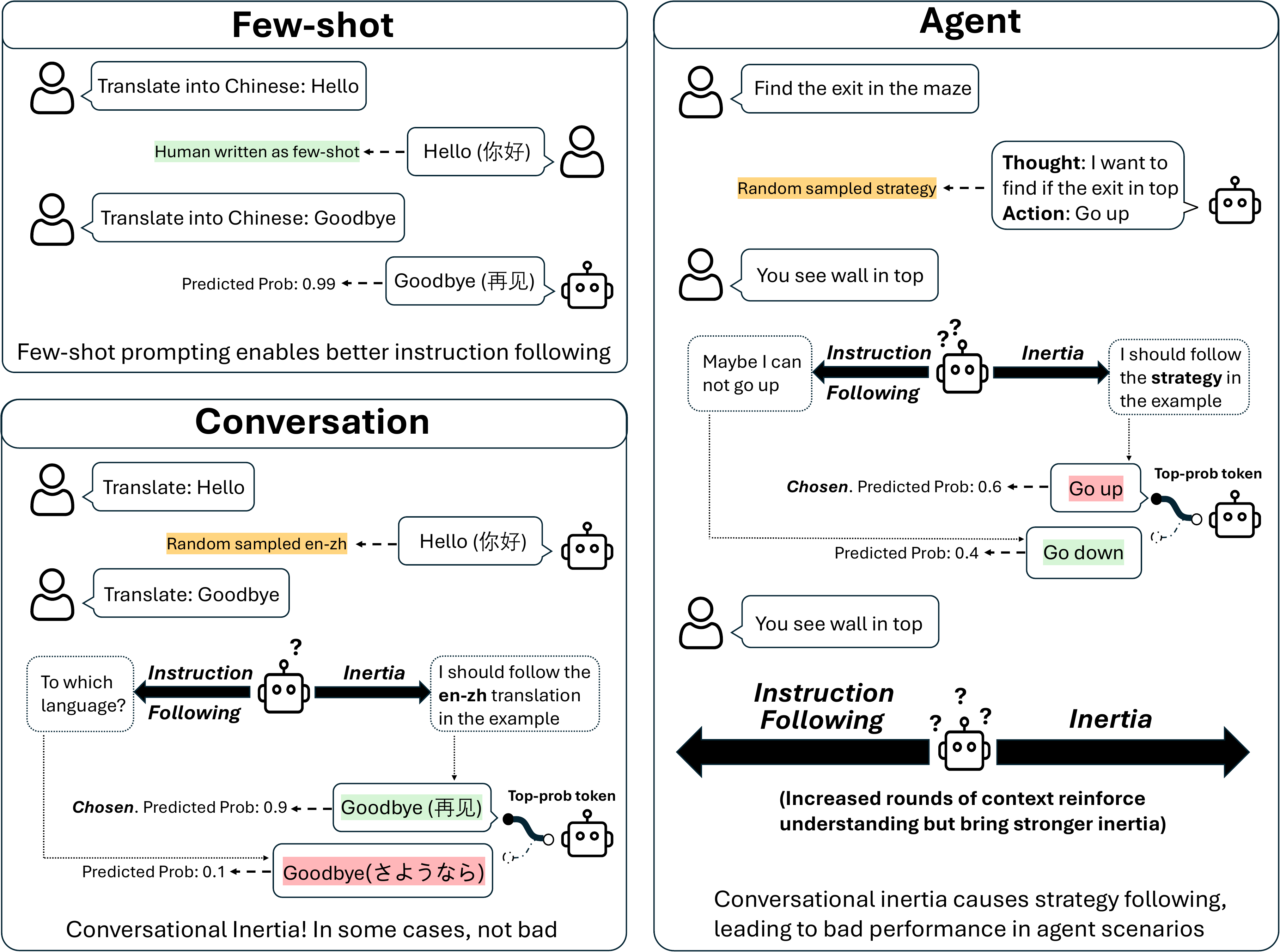
Motivation figure comparing few-shot prompting, conversation, and agent scenarios.
Conversational inertia emerges when an agent treats its previous actions as demonstrations to mimic rather than experiences to learn from.

Abstract

Large language models excel as few-shot learners when provided with appropriate demonstrations, yet this strength becomes problematic in multi-turn agent scenarios, where LLMs erroneously mimic their own previous responses as few-shot examples. Through attention analysis, we identify conversational inertia, a phenomenon where models exhibit strong diagonal attention to previous responses, which is associated with imitation bias that constrains exploration. This reveals a tension when transforming few-shot LLMs into agents: longer context enriches environmental feedback for exploitation, yet also amplifies conversational inertia that undermines exploration. Our key insight is that for identical states, actions generated with longer contexts exhibit stronger inertia than those with shorter contexts, enabling construction of preference pairs without environment rewards. Based on this, we propose Context Preference Learning to calibrate model preferences to favor low-inertia responses over high-inertia ones. We further provide context management strategies at inference time to balance exploration and exploitation. Experimental results across eight agentic environments and one deep research scenario validate that our framework reduces conversational inertia and achieves performance improvements.

Motivation

Multi-turn LLM agents solve tasks by repeatedly observing the environment, generating actions, and appending the resulting interaction history to the next prompt. This design gives the model useful feedback for exploitation, but it also changes the role of context: previous assistant outputs can start to look like few-shot demonstrations written by the model itself.

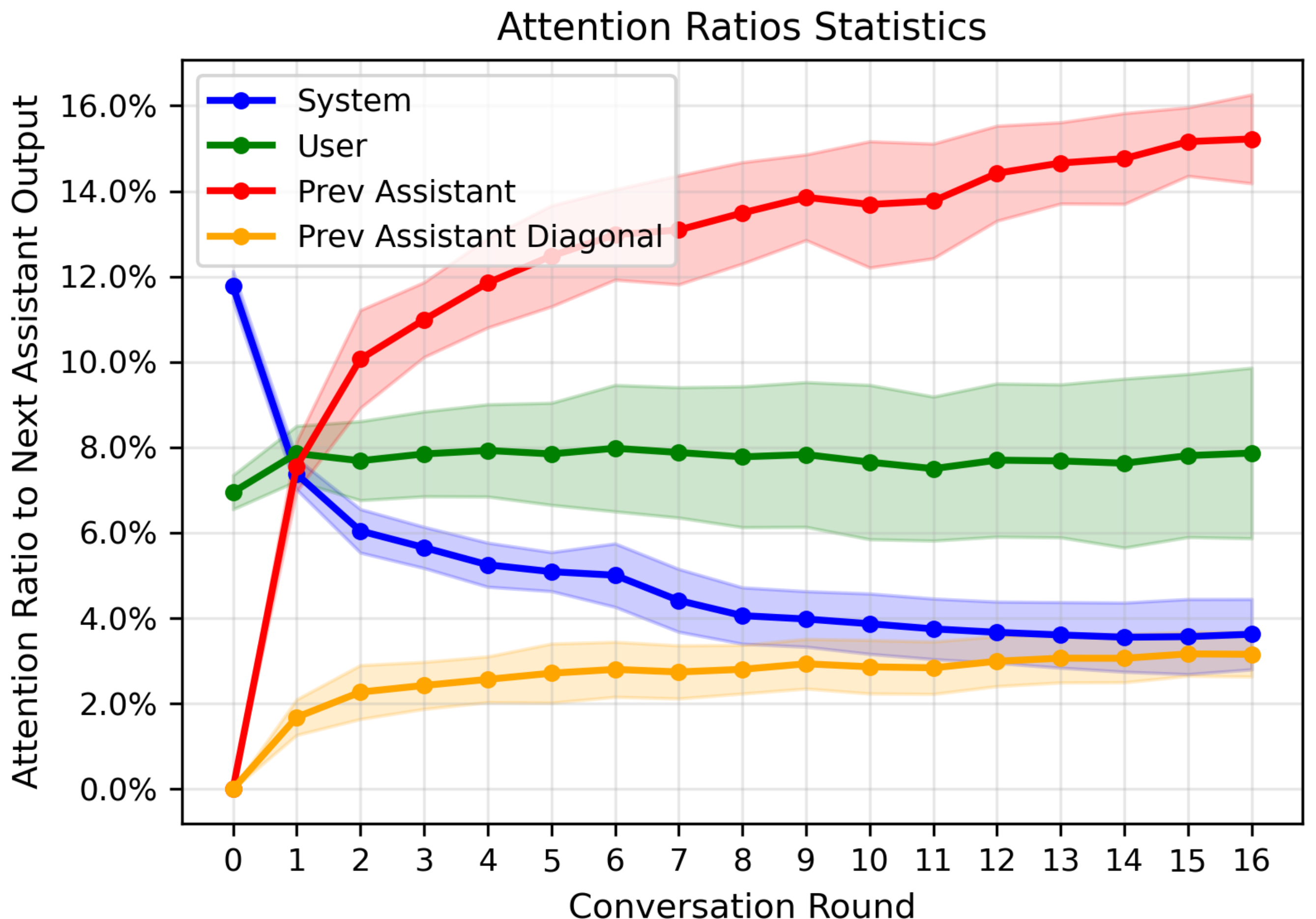
We find that longer histories do not always help. Agent performance can degrade at moderate context lengths that remain far below modern model capacity limits. Attention analysis suggests a concrete mechanism behind this degradation: models increasingly attend to their own previous responses, especially along token-aligned diagonal patterns, and become biased toward repeating earlier behavior.

We call this failure mode conversational inertia. It appears as strong diagonal attention to previous assistant responses and can make the model reproduce the structure of earlier actions instead of adapting to new observations. This motivates our two complementary mitigations: Context Preference Learning and Clip Context.
Attention ratio statistics across conversation rounds.
As conversation rounds increase, attention to previous assistant outputs grows while attention to user inputs remains comparatively stable.

Method

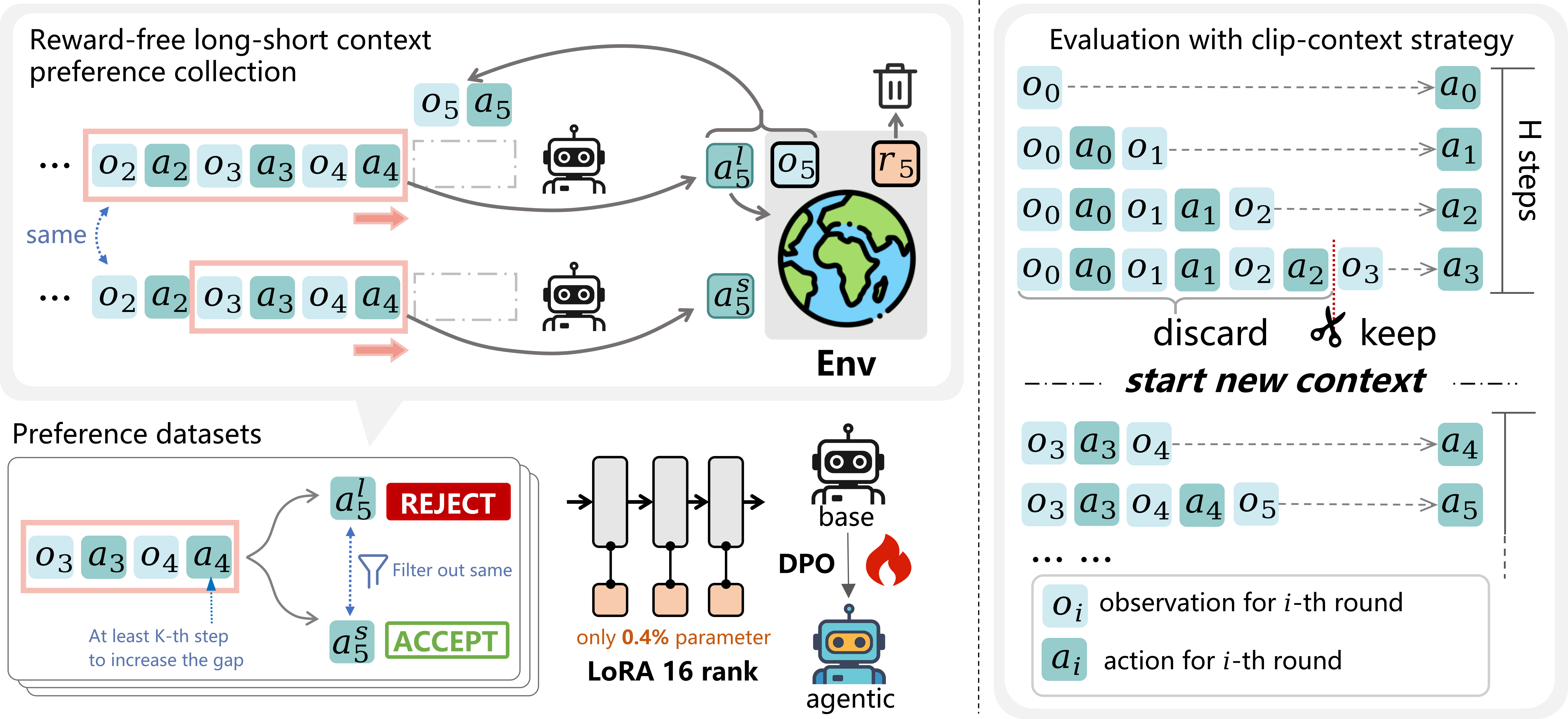
Our framework targets inertia at two levels. At the model level, Context Preference Learning teaches the model to prefer lower-inertia actions generated from shorter contexts. At the inference level, Clip Context periodically clears older interaction history to reset inertial patterns while retaining enough recent state for exploitation.

Context Preference Learning and Clip Context method overview.
Our framework combines reward-free context preference learning with a training-free clip-context inference strategy.

Context Preference Learning

CPL constructs long-short context preference pairs from the same state. Actions generated with shorter contexts tend to exhibit weaker inertia, so they serve as preferred responses over actions generated from longer histories.

The preference signal is reward-free: it does not require ground-truth task success, human annotation, or environment-specific reward modeling.

Clip Context

Clip Context clears older interaction turns at fixed intervals, creating cycles of exploration and exploitation. The agent can use recent context, but accumulated self-imitation is periodically broken.

Unlike sliding windows, clipping preserves long append-only segments between resets, which makes the method naturally compatible with KV cache reuse.

Results

We evaluate across eight agent environments that cover navigation, web interaction, text games, reasoning-dependent strategic games, and crafting scenarios. This makes the setting broad enough to test both exploration and exploitation under multi-turn interaction histories.

MZMaze navigation
ALFEmbodied household tasks
WSWebShop interaction
TCTextCraft planning
FLFrozenLake navigation
HMHangman reasoning
2048Strategic game play
RHRushHour puzzle solving

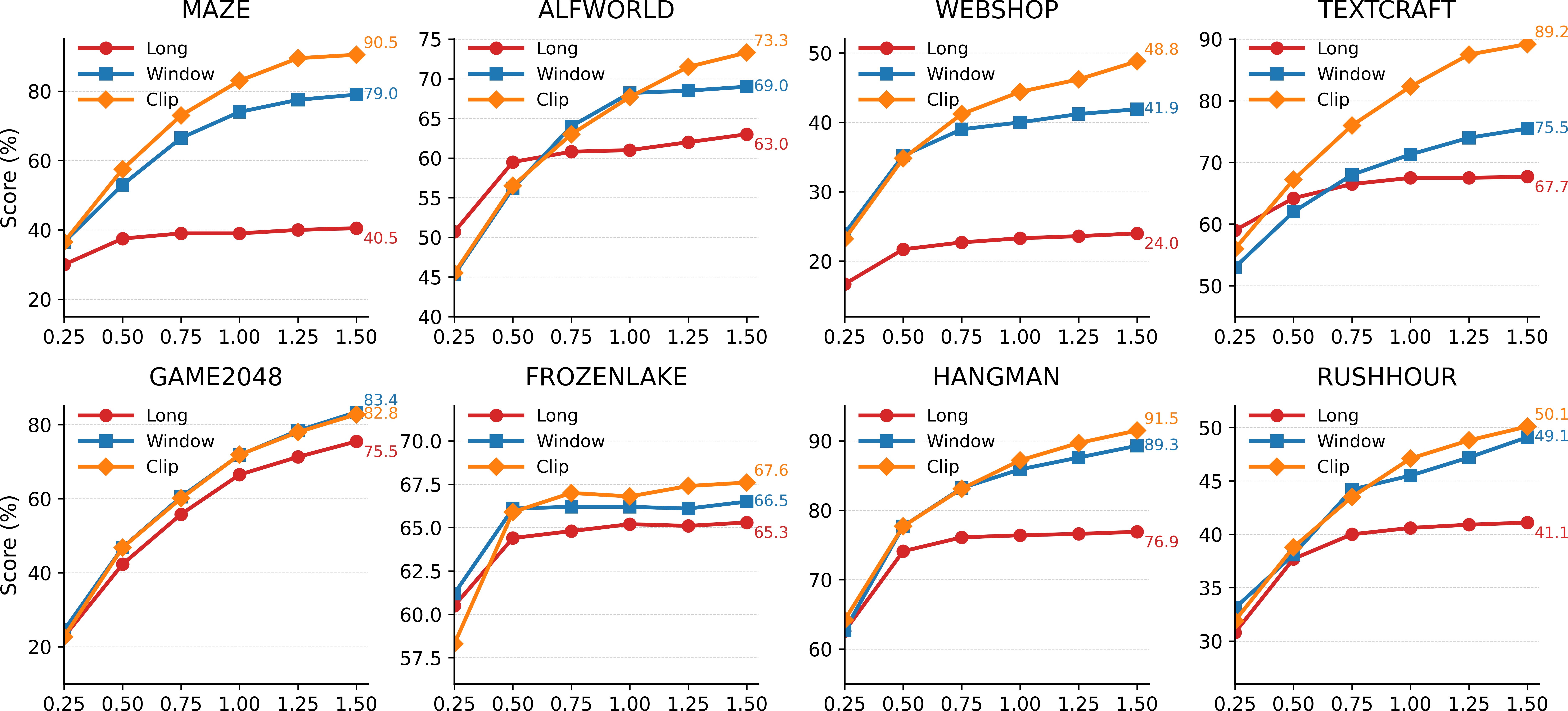
Across eight agent environments, Clip Context consistently improves over long-context and window-context baselines. Combined with CPL, the average score reaches 72.5%, compared with 68.9% for base Clip Context.

Performance scaling curves across eight agent environments.
Clip Context improves performance across environments as the context budget grows.
Comparison of CPL finetuning and context management methods on eight agent tasks.
Model Variant Context MZ ALF WS TC FL HM 2048 RH Avg
Qwen3-8B Base Window 74.068.240.071.367.585.366.945.864.9
Long 39.061.023.367.563.575.165.640.354.4
Summarization 78.071.046.580.564.688.970.650.468.8
Clip 83.067.744.482.367.585.170.950.268.9
CPL Window 78.067.544.974.568.289.572.444.367.4
Long 44.059.540.565.570.077.770.244.859.0
Summarization 87.571.552.275.269.489.971.649.170.8
Clip 91.570.354.983.068.487.573.051.172.5
Llama3.1-8B Base Window 79.721.545.468.258.687.070.138.058.6
Long 48.020.329.149.154.079.968.138.248.3
Summarization 81.531.537.662.753.888.369.838.057.9
Clip 82.528.543.670.055.984.168.740.559.2
CPL Window 79.025.344.972.055.486.567.838.958.7
Long 46.518.832.346.552.478.569.738.847.9
Summarization 77.231.539.565.056.588.668.040.458.3
Clip 82.331.543.870.056.886.368.639.359.8
GPT-4o-mini / Window 82.052.537.855.089.497.373.440.266.0
Long 62.062.045.552.087.296.872.938.464.6
Summarization 71.056.242.266.791.298.972.940.767.5
Clip 81.054.539.881.892.098.975.545.371.1

Deep Research Evaluation

We also evaluate long-term reasoning on BrowseComp, where the agent must balance information gathering, search depth, and the risk of answering too early. Clip-12to6 obtains the best score among the tested settings and remains competitive with summarization while avoiding extra summary-generation overhead.

Context management methods on BrowseComp. Proactive rate measures how often the agent answers before the step limit.
Method Score Proactive Rate Proactive Score
Window-625.0 ± 1.727.3%55.7
Window-923.4 ± 1.526.6%58.8
Window-1224.2 ± 1.825.4%58.5
Clip-12to025.0 ± 1.829.3%56.0
Sum-12to027.7 ± 2.063.7%37.4
Clip-12to629.3 ± 1.530.9%61.0
Sum-12to628.1 ± 1.630.8%63.3
Retain some objective history Clip-12to6 improves over fully clearing history, indicating that inertia control and information preservation must be balanced.
Summaries can be over-confident Sum-12to0 answers much more proactively, but its proactive answer accuracy is substantially lower.
Clipping is lightweight Clip-12to6 is comparable to Sum-12to6 without requiring a separate model-generated summary.

Attention Pattern Analysis

The two mitigation mechanisms affect attention differently. Clip Context directly changes the available history and reduces diagonal attention by removing accumulated assistant traces. Context Preference Learning reduces diagonal attention while keeping overall assistant attention comparatively stable, suggesting that the model learns to use history less positionally and less imitatively.

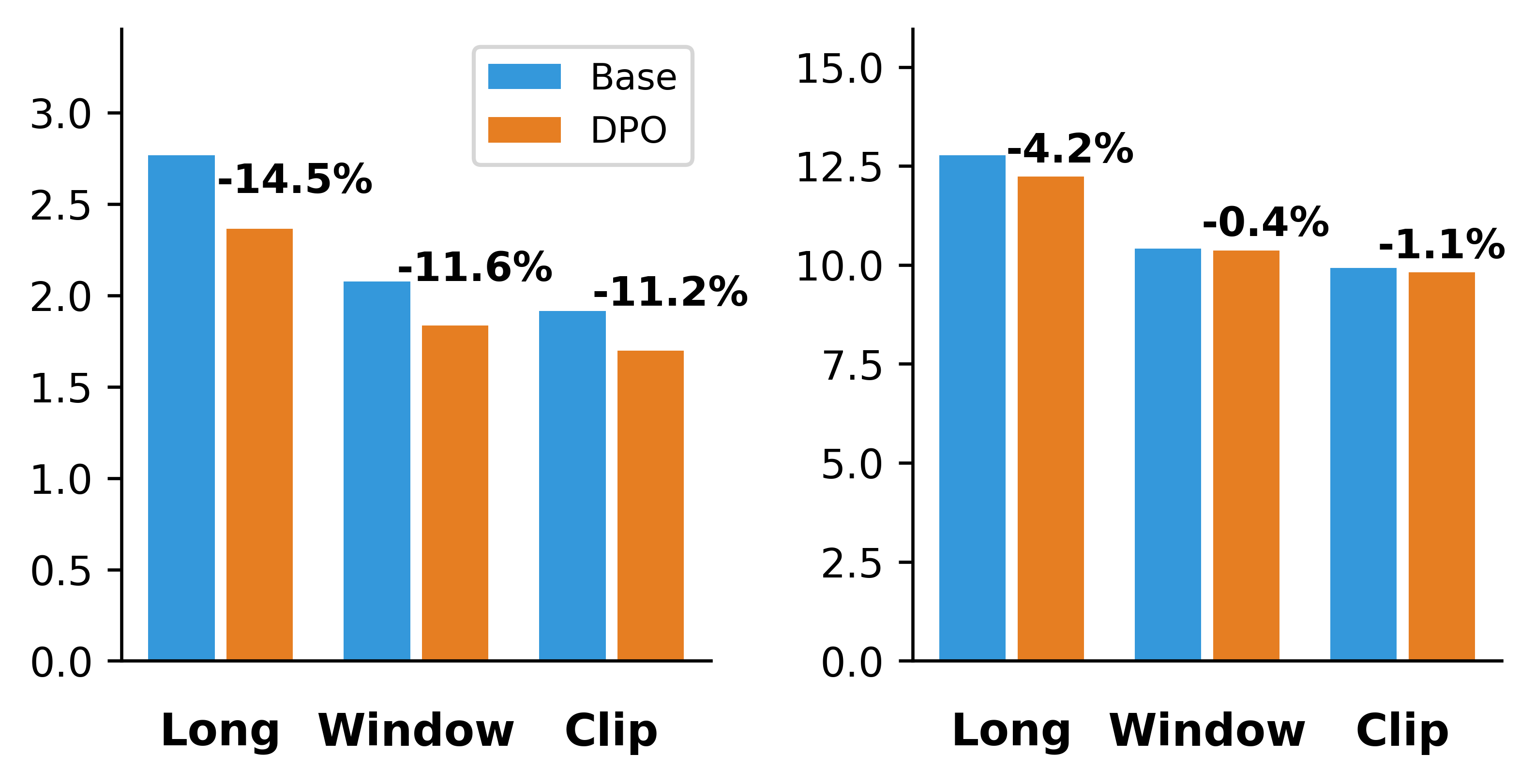
Clip Context attention comparison.
Clip Context reduces diagonal attention and increases system attention.
Context Preference Learning attention comparison.
CPL reduces diagonal attention across context management methods.

Computational Efficiency

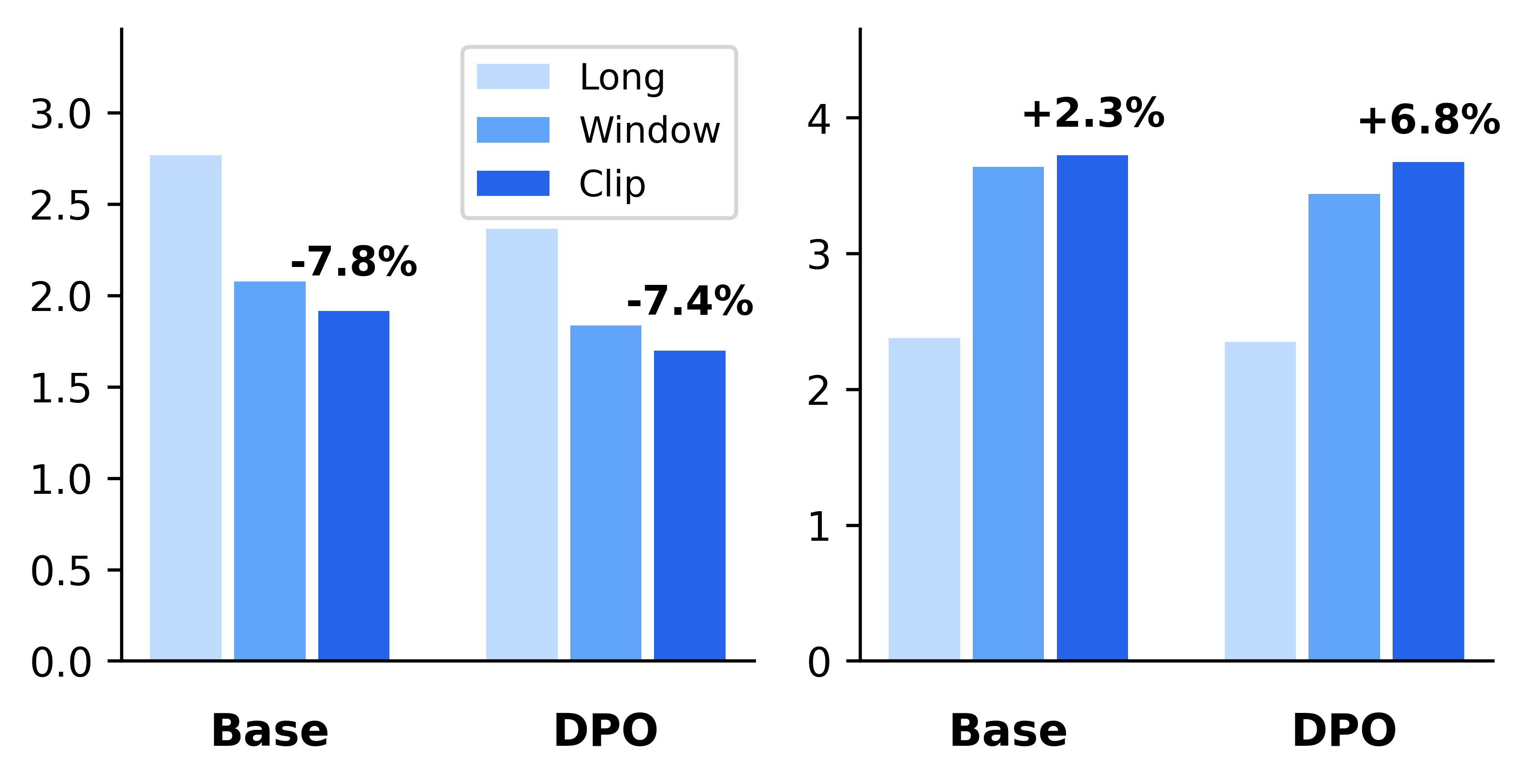
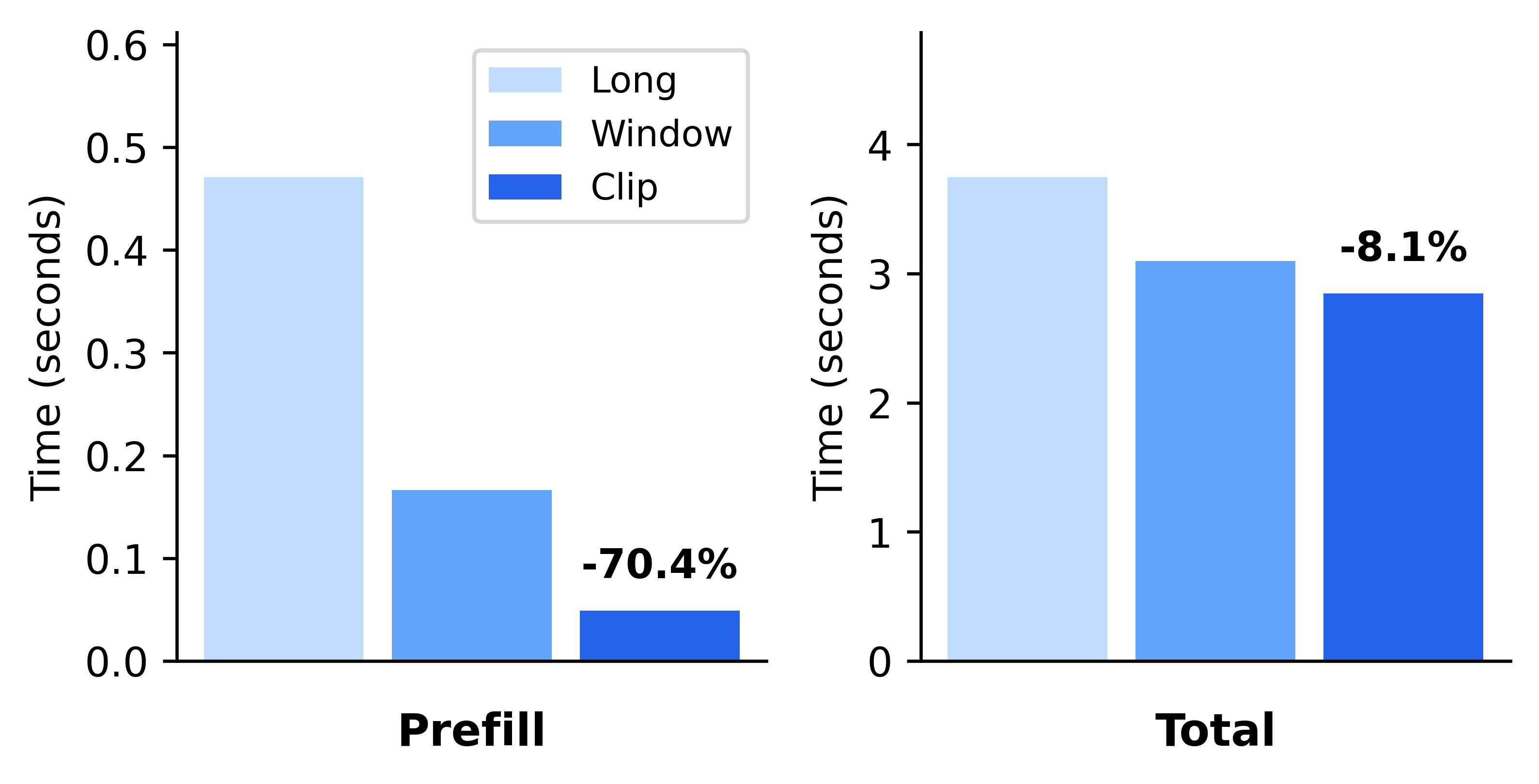
Clip Context is not only a behavioral intervention. Because it preserves append-only generation between clip operations, it can reuse KV cache more effectively than sliding-window truncation. In our speed benchmark, Clip achieves a 2-7x prefill speedup over window methods while maintaining strong task performance.

Prefill and total time comparison for context methods.
Clip Context reduces prefill time substantially and keeps total inference time competitive with or better than window-based context management.

BibTeX

@article{wan2026mitigating,
  author    = {Wan, Yang and Cao, Zheng and Zhang, Zhenhao and Zeng, Zhengwen and Shen, Shuheng and Meng, Changhua and Zhu, Linchao},
  title     = {Mitigating Conversational Inertia in Multi-Turn Agents},
  journal   = {arXiv preprint arXiv:2602.03664},
  year      = {2026},
}